
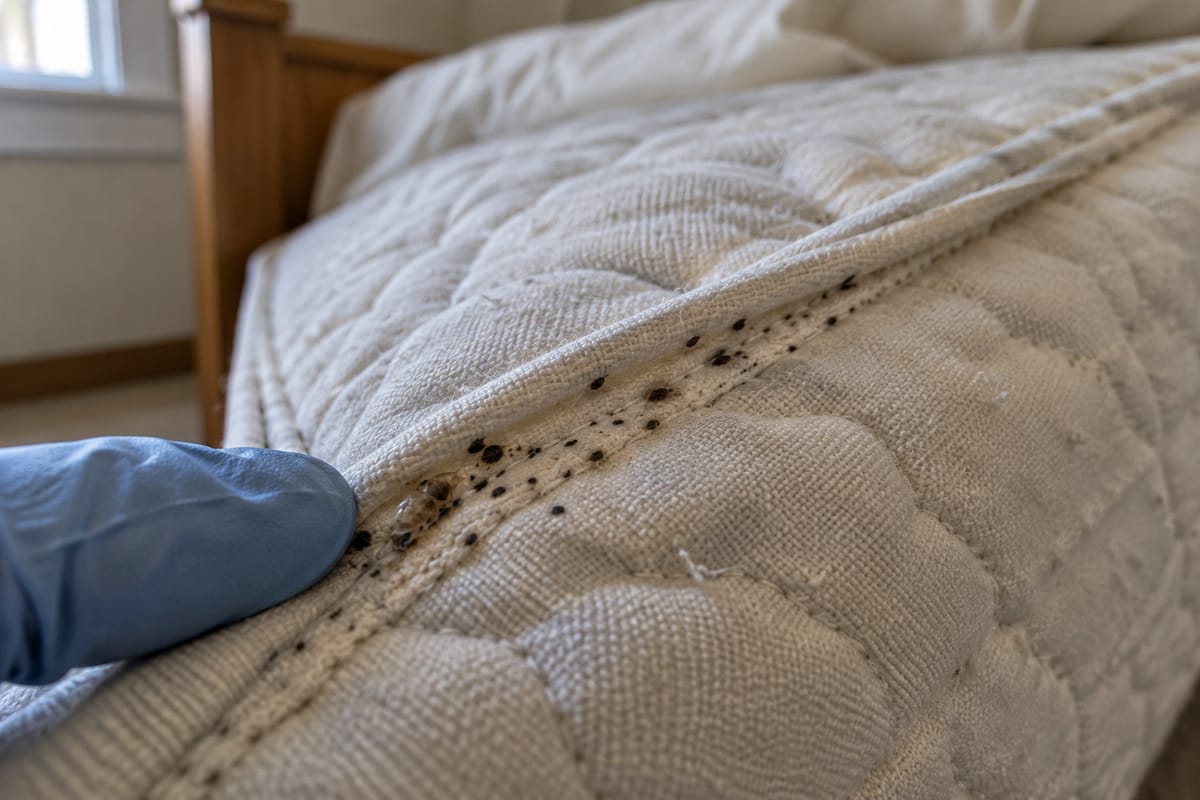
Take a breath. You can learn a great deal on your own with a flashlight and about twenty minutes. Here is how to tell whether you have bed bugs, and what to do next.
Don’t go by the bites
Bites are the weakest clue you have. Some people do not react to bed bug bites at all — around 30% by University of Kentucky’s reckoning. Two people can sleep in the same bed and one wakes up covered in welts while the other has nothing.
Bites can also take days to appear, sometimes up to a couple of weeks. So the night you were bitten and the morning you noticed may not be close together at all.
That is why we do not start with your arm. We start with your mattress. A professional bed bug inspection looks for the insects themselves and the mess they leave behind.
The four signs worth looking for
Dark spots. This is the big one. Bed bug droppings look like tiny dots from a marker pen, and the giveaway is that they soak into the fabric rather than sitting on top of it. Rub one with a damp white cloth: if it smears rusty brown, pay attention. Check the seams, the tag, and the underside of the box spring.
Shed skins. Young bed bugs shed their skins as they grow. The skins are pale tan, translucent and empty. Finding them means bed bugs are living and growing in the room rather than passing through.
Eggs. Tiny, white, about the size of a pinhead, and cemented in place. Because eggs cannot move, they show you exactly where the insects are hiding.
The insects. Adults are flat, oval, reddish-brown and about the size of an apple seed. They cannot fly or jump. The young are much smaller and almost clear until they have fed.
The kind of home you live in matters
Bed bugs do not care how clean your house is or what you earn. What matters far more is how the building is put together and who you share walls with — and our service area has a bit of everything.
Shared walls. Milford has the lowest share of detached housing anywhere we cover, with a substantial number of units in multi-family buildings, and there is older attached and adjoining stock in Mariemont and Batavia too. In a building like that, your neighbour’s bed bugs become your bed bugs: they travel through wall voids, along pipes and under doors. It is why we ask about the units next door, and why a single quick treatment rarely finishes the job.
Older homes. Around 31% of Hamilton County’s housing was built before 1950, which takes in a lot of Madeira and Mariemont. Older houses have more gaps in the trim, the baseboards and the plaster — more places for an insect as thin as a credit card to spend the day.
Detached houses on their own lot. If you live in one and find bed bugs, they did not come through a wall. Somebody carried them in on a suitcase, a second-hand couch or a bag coming home from a dorm. That is good news of a kind: once they are gone from the house, they tend to stay gone.
Where to check, in order
Start at the bed and work outwards.
- Mattress seams, edges and the tag
- Box spring, top and underneath — pull back the thin fabric on the bottom
- Bed frame and headboard, especially joints and screw holes
- Nightstands and dressers, including drawer corners and undersides
- Couches and armchairs, along the seams and under the cushions
- Carpet edges and baseboards
- Behind picture frames, mirrors and outlet covers
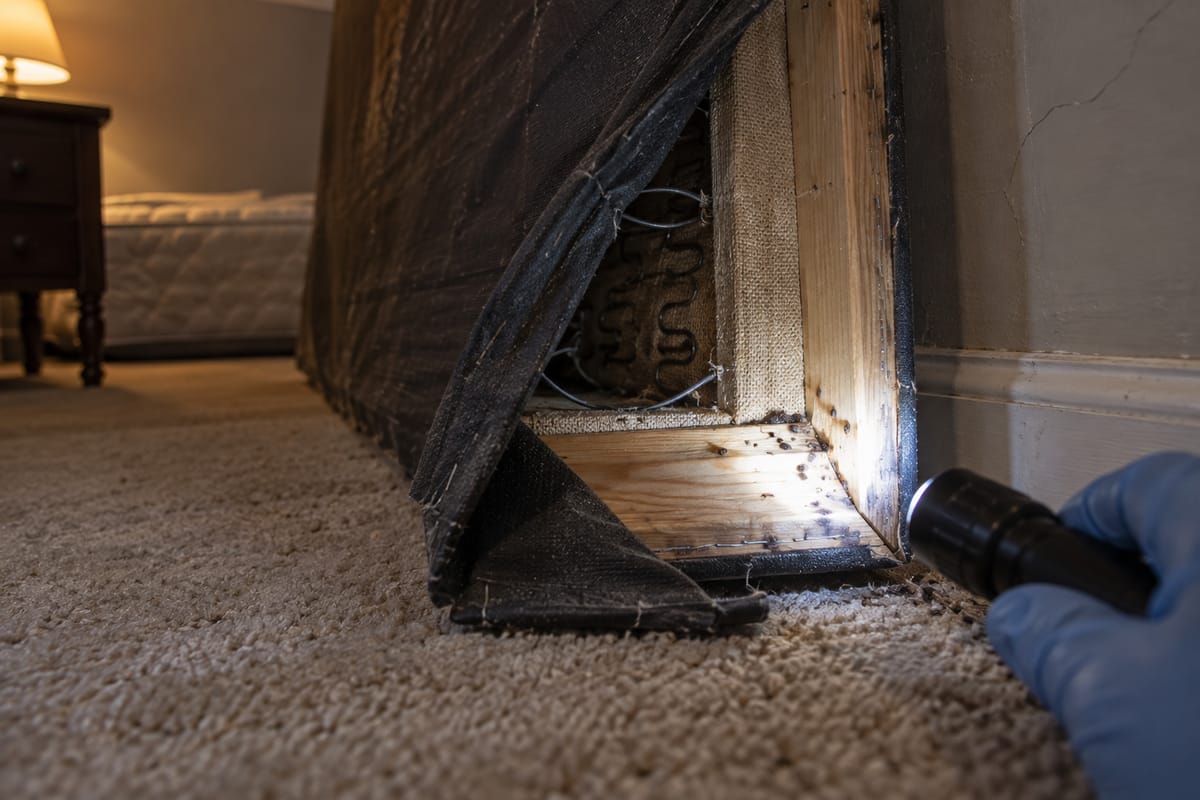
Do not stop at the bed. Bed bugs will crawl several feet to reach you at night, and plenty of them spend the day away from the bed entirely. In an older house, check the baseboards properly — there are simply more cracks to search. In newer construction, the bed and the furniture around it are usually where you will find them first.
What gets mistaken for bed bugs
Most of what people bring us is not a bed bug.
Bat bugs. These look almost identical and you need magnification to tell them apart. It matters, because bat bugs mean bats are living in the attic or the chimney, and bed bug treatment will not fix that.
Carpet beetle larvae. The most common false alarm by a distance. They are fuzzy and striped; bed bugs are smooth. If it is fuzzy, it is not a bed bug.
Spider beetles. Round and shiny, like a small bead with legs. They can pass for a bed bug that has just fed, but they are humped rather than flat.
A tip: stick the insect to a piece of clear tape on an index card before you call anybody. Finding out what it is costs nothing and can save you a great deal.
Why store-bought sprays don’t work
Before you head to the hardware store, you should know that the bug bombs and sprays on the shelf barely touch bed bugs any more.
They have built up resistance to the common over-the-counter chemicals over the years, and some of the populations that helped researchers demonstrate that were collected here in Cincinnati. When Ohio State tested consumer bug bombs on bed bugs taken from real homes, roughly 2% of them died.
It gets worse. Some sprays repel rather than kill, so instead of ending the problem you push it into the next room. In an apartment or a duplex, that next room may be your neighbour’s.
What to do right now
Do this. Catch an insect if you can, and photograph what you found and where. Strip the bed and seal the bedding in a bag. Wash it hot and dry it on high for at least 30 minutes. If you rent, tell your landlord in writing today. Then arrange a professional bed bug treatment.
Don’t sleep on the couch. Almost everybody wants to, and it is the worst thing you can do. Bed bugs find you by body heat and breath. If you move, they follow, and now there are two rooms to treat. Waiting them out does not work either — adults can go months without feeding.
Don’t throw out the mattress. Most of the time you do not need to. The insects are also in the box spring, the frame and the baseboards, dragging a mattress down a hallway spreads them, and the ones left behind will find the new mattress quickly.
Don’t set off a bug bomb. See above.
Common questions
Does keeping a clean house protect me?
No. Bed bugs feed on blood, not crumbs. We have found them in spotless homes.
I live in a detached house. How did I get them?
Somebody brought them in — a trip, a guest, a second-hand piece of furniture, a child home from college. Where there are no shared walls, that is almost always the answer.
My neighbour has them. What should I do?
Get your own place checked now rather than waiting for bites. In a shared building, treating one unit on its own rarely holds.
Why does it take more than one visit?
Eggs are far harder to kill than adults, and they hatch over the following week or two. A follow-up visit catches that generation before it matures and lays. It is not an upsell — it is how the egg cycle works.
Let’s find out what you’re dealing with
If you found dark spots on your box spring this morning, you do not need to spend the weekend reading forums. You need someone to look.
We are veteran-owned, and these are our neighbourhoods too. We cover Loveland, Milford, Madeira, Indian Hill, Mariemont, Batavia, Amelia and Withamsville, plus Cincinnati and Northern Kentucky.
And if it turns out to be carpet beetles, we will tell you. We are not going to sell you a treatment you do not need.